Description
Video
Checkpoint demonstration
Hurtbox demonstration
My work
I focused on a pause system that does not rely on Time.timeScale. Instead, a centralized GameStateHandler drives the paused state, and player logic explicitly freezes movement + gravity + animation, while storing/restoring values to avoid bugs (like infinite jumping when pausing mid-air).
GameStateHandler (singleton + state machine + pause/resume)
public enum GameState
{
  Playing,
  Paused,
  GameOver
}

public class GameStateHandler : MonoBehaviour
{
  public static GameStateHandler Instance { get; private set; }
  public GameState CurrentState { get; private set; } = GameState.Playing;

  public Animator[] animators;

  private UIManager uiManager;
  private PlayerMovement playerMovement;

  public bool isGameOver = false;

  void Awake()
  {
    if (Instance == null) Instance = this;
    else { Destroy(gameObject); return; }

    uiManager = GetComponent<UIManager>();
    if (uiManager == null)
    {
      Debug.Log("UIManager not found in scene, please attach.");
    }
  }

  void Start()
  {
    if (uiManager != null) uiManager.OnResumePress();
  }

  public void ChangeState(GameState newState)
  {
    if (CurrentState == newState) return;
    CurrentState = newState;

    switch (newState)
    {
      case GameState.Paused:   PauseGame();  break;
      case GameState.Playing:  ResumeGame(); break;
      case GameState.GameOver: GameOver();   break;
    }
  }

  public void TogglePause()
  {
    if (CurrentState == GameState.Playing) ChangeState(GameState.Paused);
    else if (CurrentState == GameState.Paused) ChangeState(GameState.Playing);
  }

  public void PauseGame()
  {
    Debug.Log("Game Paused");

    foreach (Animator animator in animators)
    {
      animator.enabled = false;
    }
  }

  public void ResumeGame()
  {
    if (uiManager != null) uiManager.OnResumePress();
    Debug.Log("Game Resumed");

    ChangeState(GameState.Playing);
  }

  public void GameOver()
  {
    if (CurrentState == GameState.Paused) ResumeGame();

    ChangeState(GameState.GameOver);
    isGameOver = true;
    Debug.Log("Game Over");

    if (playerMovement != null) playerMovement.enabled = false;
  }
}
Player pause guard (freeze gravity + animation, restore cleanly)
// PlayerMovement
if (GameStateHandler.Instance != null &&
    GameStateHandler.Instance.CurrentState == GameState.Paused)
{
  if (ani != null && ani.speed != 0)
  {
    previousAnimatorSpeed = ani.speed;
    ani.speed = 0;
  }

  if (rb.useGravity)
  {
    isGravityEnabled = true;
    rb.useGravity = false;
    rb.linearVelocity = Vector3.zero;
  }

  transform.position = previousPosition;
  return;
}
else
{
  if (!isGravityEnabled && rb.useGravity == false)
  {
    rb.useGravity = true;
  }

  if (ani != null && ani.speed == 0 && previousAnimatorSpeed != 0)
  {
    ani.speed = previousAnimatorSpeed;
  }
}
Checkpoint trigger (store respawn point + feedback)
public class Checkpoint : MonoBehaviour
{
  private Respawner respawner;
  private BoxCollider checkPointCollider;

  public ParticleSystem effect;
  [System.NonSerialized] public AudioManager audioManager;

  void Awake()
  {
    checkPointCollider = GetComponent<BoxCollider>();
    respawner = GameObject.FindGameObjectWithTag("Respawn").GetComponent<Respawner>();
    audioManager = GameObject.FindGameObjectWithTag("Audio").GetComponent<AudioManager>();
  }

  private void OnTriggerEnter(Collider other)
  {
    if (other.gameObject.CompareTag("Player"))
    {
      respawner.respawnPoint = this.gameObject;
      checkPointCollider.enabled = false;

      audioManager.PlaySFX(audioManager.checkpoint);
      effect.Play(true);
    }
  }
}
Damage source trigger (hurt / death routing)
public class DamageSource : MonoBehaviour
{
  PlayerUI playerUI;
  PlayerMovement player;
  CollectionSystem collectionSystem;

  void Awake()
  {
    player = gameObject.GetComponent<PlayerMovement>();
    collectionSystem = GetComponent<CollectionSystem>();

    if (collectionSystem != null)
    {
      playerUI = collectionSystem.playerUI;
    }
  }

  void OnTriggerEnter(Collider other)
  {
    if (other.gameObject.tag == "Enemy")
    {
      if (collectionSystem != null && playerUI != null)
      {
        player.GotHurt();
        playerUI.MinusHealth();
      }
      else
      {
        Debug.Log("Collection system or PlayerUI is missing");
      }
    }

    if (other.gameObject.tag == "Serpent")
    {
      playerUI.Death();
    }
  }
}
Description
Video
Driving demonstration
My work
Modular approach: a base vehicle pawn holds shared driving behaviors (input, drift, boost, reset), while each car type focuses on tuning data. A unified controller swaps between FPS and vehicle pawns and swaps input mapping contexts.
Base car pawn: shared setup + driving hooks
// Base: shared components + chaos movement access
SetRootComponent(GetMesh());

InteriorSpringArm = CreateDefaultSubobject<USpringArmComponent>(TEXT("Interior Spring Arm"));
InteriorSpringArm->SetupAttachment(GetMesh());

InteriorCamera = CreateDefaultSubobject<UCameraComponent>(TEXT("Interior Camera"));
InteriorCamera->SetupAttachment(InteriorSpringArm, USpringArmComponent::SocketName);

ChaosVehicleMovement = CastChecked<UChaosWheeledVehicleMovementComponent>(GetVehicleMovement());
GetMesh()->SetSimulatePhysics(true);
GetMesh()->SetCollisionProfileName(FName("Vehicle"));
Drift: reduce grip + increase angular damping
// Drift
bIsDrifting = true;

for (auto& WheelSetup : ChaosVehicleMovement->WheelSetups)
{
  if (WheelSetup.WheelClass)
  {
    WheelSetup.WheelClass.GetDefaultObject()->FrictionForceMultiplier
      = DefaultGrip * DriftGripReduction;
  }
}

GetMesh()->SetAngularDamping(DefaultAngularDrag * DriftAngularDragMultiplier);
ChaosVehicleMovement->SetHandbrakeInput(true);
Nitro: temporary engine boost + impulse
// Nitro boost
bIsBoosting = true;
bCanBoost = false;

float OriginalMaxTorque = ChaosVehicleMovement->EngineSetup.MaxTorque;
float OriginalMaxRPM = ChaosVehicleMovement->EngineSetup.MaxRPM;

ChaosVehicleMovement->EngineSetup.MaxTorque *= BoostMultiplier;
ChaosVehicleMovement->EngineSetup.MaxRPM *= 2.5f;

GetMesh()->AddImpulse(GetActorForwardVector() * BoostThrust);
Car feel: muscle car tuning
// MuscleCar: tuning values live in the derived class
GetChaosVehicleMovement()->WheelSetups.SetNum(4);

GetChaosVehicleMovement()->WheelSetups[0].WheelClass = UCPP_BasicFrontWheel::StaticClass();
GetChaosVehicleMovement()->WheelSetups[2].WheelClass = UCPP_BasicRearWheel::StaticClass();

GetChaosVehicleMovement()->EngineSetup.MaxTorque = 750.f;
GetChaosVehicleMovement()->EngineSetup.MaxRPM = 7000.0f;
Unified controller: swap pawns + swap input mapping contexts
// Pawn swap + mapping context swap
Subsystem->ClearAllMappings();

if (NewPawn == VehiclePawn && CarInputMappingContext)
{
  Subsystem->AddMappingContext(CarInputMappingContext, 0);
}
else if (NewPawn == FPSPawn && FPSInputMappingContext)
{
  Subsystem->AddMappingContext(FPSInputMappingContext, 0);
}

Possess(NewPawn);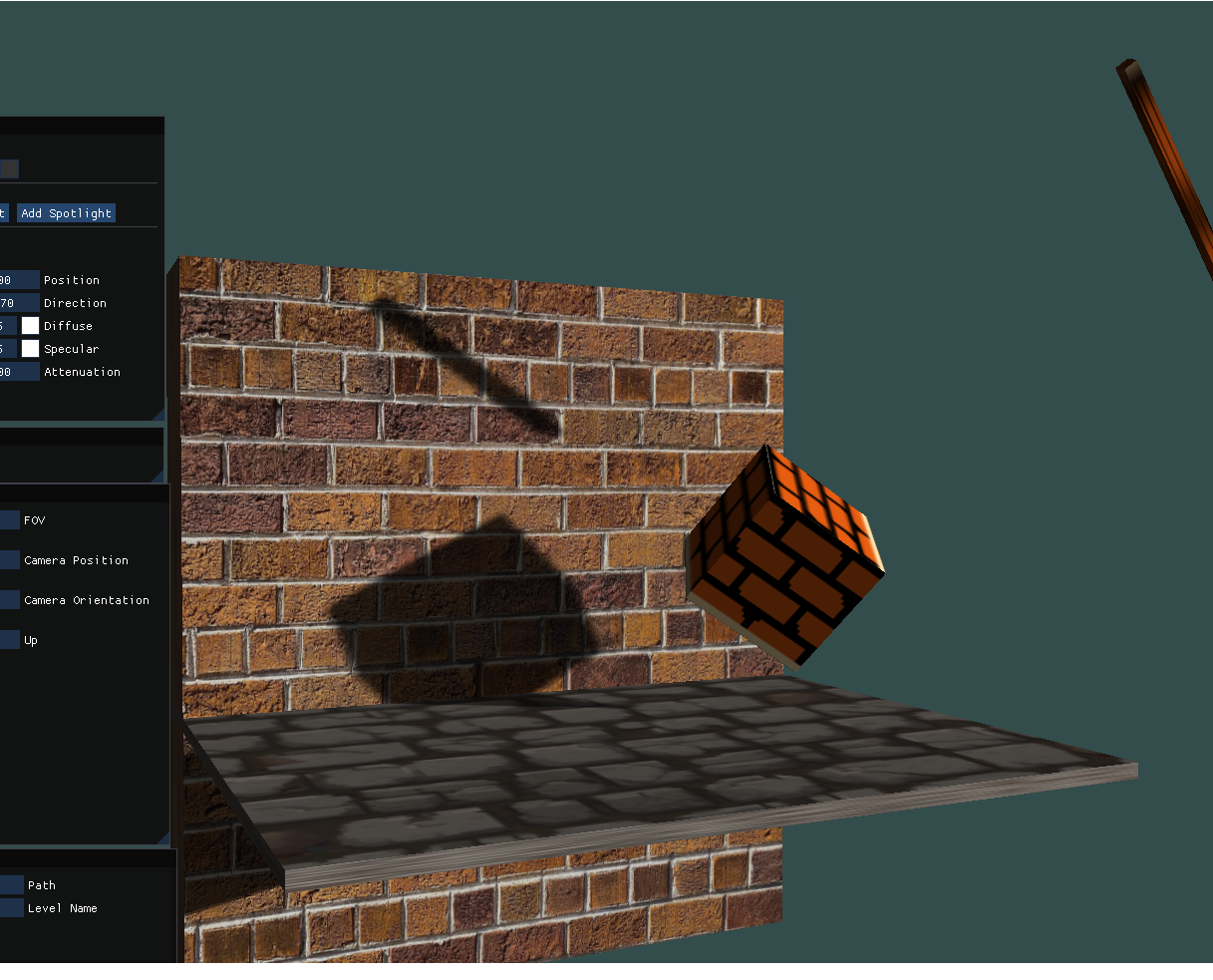
Description
The in-engine UI allows us to spawn entities and play around with them.
At its current stage, the engine can:
• Render basic 3D and 2D objects.
• Load meshes via a .obj loader.
• Apply diffuse + specular textures.
• Configure lighting in real time (Directional / Point / Spot) with support for up to 16 lights.
• Use ImGui panels to spawn/edit entities, adjust render settings, and debug systems while running.
• Save/load entity data via JSON serialization.
Video
Short demo showing shadow mapping and some short gameplay footage
My work
DumpsterFireEngine code snippets
Highlights from the engine: AABB collision detection/resolution, and a shadow mapping pipeline (depth FBO + PCF sampling).
AABB bounds (from transform) Axis-aligned bounding box built from position + scale (half-extents).
struct AABB
{
    glm::vec3 min;
    glm::vec3 max;

    AABB() : min(0.0f), max(0.0f) {}

    AABB(const glm::vec3& center, const glm::vec3& halfExtents) : min(center - halfExtents), max(center + halfExtents) {}

    static AABB FromTransform(const glm::vec3& position, const glm::vec3& scale)
    {
        glm::vec3 halfExtents = scale * 0.5f;
        return AABB(position, halfExtents);
    }

    glm::vec3 GetCenter() const {return (min + max) * 0.5f;}
    glm::vec3 GetExtents() const {return (max - min) * 0.5f;}
};
Collision test (minimum penetration axis) Overlap test on X/Y/Z; early-out if separated; chooses smallest overlap axis and signs it using centers.
bool PhysicsManager::bCheckAABBCollision(const AABB& a, const AABB& b, CollisionInfo& outInfo)
{
    outInfo = CollisionInfo{};

    const float overlapX = std::min(a.max.x, b.max.x) - std::max(a.min.x, b.min.x);
    const float overlapY = std::min(a.max.y, b.max.y) - std::max(a.min.y, b.min.y);
    const float overlapZ = std::min(a.max.z, b.max.z) - std::max(a.min.z, b.min.z);

    const float eps = 0.0001f;
    if (overlapX <= eps || overlapY <= eps || overlapZ <= eps)
        return false;

    float minOverlap = overlapX;
    glm::vec3 axis(1.0f, 0.0f, 0.0f);

    if (overlapY < minOverlap)
    {
        minOverlap = overlapY;
        axis = glm::vec3(0.0f, 1.0f, 0.0f);
    }
    if (overlapZ < minOverlap)
    {
        minOverlap = overlapZ;
        axis = glm::vec3(0.0f, 0.0f, 1.0f);
    }

    const glm::vec3 aCenter = a.GetCenter();
    const glm::vec3 bCenter = b.GetCenter();
    glm::vec3 dir = aCenter - bCenter;

    if (axis.x != 0.0f) axis.x = (dir.x >= 0.0f) ? 1.0f : -1.0f;
    if (axis.y != 0.0f) axis.y = (dir.y >= 0.0f) ? 1.0f : -1.0f;
    if (axis.z != 0.0f) axis.z = (dir.z >= 0.0f) ? 1.0f : -1.0f;

    outInfo.bCollided = true;
    outInfo.contactAxis = axis;
    outInfo.contactDepth = minOverlap;
    return true;
}
Collision resolution (separation + grounded) After detection: runs callback, computes separation correction, handles static vs dynamic objects, updates AABBs, resolves response, and sets grounded state for the player.
// collision detection + resolution + separation
for (size_t i = 0; i < physicsComponents.size(); i++)
{
    for (size_t j = i + 1; j < physicsComponents.size(); j++)
    {
        CollisionInfo info;
        if (!bCheckAABBCollision(collisionBoxes[i], collisionBoxes[j], info))
            continue;

        if (collisionCallback)
        {
            collisionCallback((int)i, (int)j, entityTypes[i], entityTypes[j]);
        }

        const float slop = 0.001f;
        float sep = info.contactDepth + slop;
        glm::vec3 correction = info.contactAxis * sep;

        PhysicsComponent& physA = physicsComponents[i];
        PhysicsComponent& physB = physicsComponents[j];

        bool AStatic = physA.bIsKinematic || entityTypes[i] == CollisionType::OBSTACLE || entityTypes[i] == CollisionType::PLATFORM;
        bool BStatic = physB.bIsKinematic || entityTypes[j] == CollisionType::OBSTACLE || entityTypes[j] == CollisionType::PLATFORM;

        if (!AStatic && BStatic)
        {
            cubes[i].position += correction;
        }
        else if (AStatic && !BStatic)
        {
            cubes[j].position -= correction;
        }
        else if (!AStatic && !BStatic)
        {
            cubes[i].position += correction * 0.5f;
            cubes[j].position -= correction * 0.5f;
        }

        collisionBoxes[i] = AABB::FromTransform(cubes[i].position, cubes[i].scale);
        collisionBoxes[j] = AABB::FromTransform(cubes[j].position, cubes[j].scale);

        ResolveCollision((int)i, (int)j, info);

        if (entityTypes[i] == CollisionType::PLAYER && info.contactAxis.y > 0.5f)
        {
            physicsComponents[i].bGrounded = true;
            physicsComponents[i].groundNormal = info.contactAxis;
        }

        if (entityTypes[j] == CollisionType::PLAYER && info.contactAxis.y < -0.5f)
        {
            physicsComponents[j].bGrounded = true;
            physicsComponents[j].groundNormal = -info.contactAxis;
        }
    }
}
Shadow mapping
Bias matrix Transforms clip-space (-1..1) into texture-space (0..1) before sampling the shadow map.
glm::mat4 BasicShadowMapper::BiasMatrix()
{
    glm::mat4 bias(1.0f);
    bias[0][0] = 0.5f; bias[1][1] = 0.5f; bias[2][2] = 0.5f;
    bias[3][0] = 0.5f; bias[3][1] = 0.5f; bias[3][2] = 0.5f;
    return bias;
}
Depth framebuffer + depth texture Creates a depth-only framebuffer and configures the depth texture for hardware depth compare (sampler2DShadow).
void BasicShadowMapper::Init(light& lightSource)
{
    if (lightSource.shadowFrameBuffer != 0 && lightSource.shadowDepthTexture != 0) return;

    glGenFramebuffers(1, &lightSource.shadowFrameBuffer);
    glGenTextures(1, &lightSource.shadowDepthTexture);
    glBindTexture(GL_TEXTURE_2D, lightSource.shadowDepthTexture);

    glTexImage2D(GL_TEXTURE_2D, 0, GL_DEPTH_COMPONENT24, lightSource.shadowMapResolution.x, lightSource.shadowMapResolution.y, 0, GL_DEPTH_COMPONENT, GL_FLOAT, nullptr);

    glTexParameteri(GL_TEXTURE_2D, GL_TEXTURE_MIN_FILTER, GL_LINEAR);
    glTexParameteri(GL_TEXTURE_2D, GL_TEXTURE_MAG_FILTER, GL_LINEAR);


    glTexParameteri(GL_TEXTURE_2D, GL_TEXTURE_WRAP_S, GL_CLAMP_TO_BORDER);
    glTexParameteri(GL_TEXTURE_2D, GL_TEXTURE_WRAP_T, GL_CLAMP_TO_BORDER);
    const float border[4] = { 1.f, 1.f, 1.f, 1.f };
    glTexParameterfv(GL_TEXTURE_2D, GL_TEXTURE_BORDER_COLOR, border);

    glTexParameteri(GL_TEXTURE_2D, GL_TEXTURE_COMPARE_MODE, GL_COMPARE_REF_TO_TEXTURE);
    glTexParameteri(GL_TEXTURE_2D, GL_TEXTURE_COMPARE_FUNC, GL_LEQUAL);

    glBindFramebuffer(GL_FRAMEBUFFER, lightSource.shadowFrameBuffer);
    glFramebufferTexture2D(GL_FRAMEBUFFER, GL_DEPTH_ATTACHMENT, GL_TEXTURE_2D, lightSource.shadowDepthTexture, 0);

    glDrawBuffer(GL_NONE);
    glReadBuffer(GL_NONE);

    glBindFramebuffer(GL_FRAMEBUFFER, 0);
    glBindTexture(GL_TEXTURE_2D, 0);
}
Directional light depth pass (light-space matrix) Renders depth from a directional light POV using an orthographic projection; stores shadowMapMatrix for sampling later.
void BasicShadowMapper::BeginDirectionalLight(light& lightSource)
{
    Init(lightSource);

    glViewport(0, 0, lightSource.shadowMapResolution.x, lightSource.shadowMapResolution.y);
    glBindFramebuffer(GL_FRAMEBUFFER, lightSource.shadowFrameBuffer);
    glClear(GL_DEPTH_BUFFER_BIT);

    //glEnable(GL_CULL_FACE);
    //glCullFace(GL_FRONT);

    const glm::vec3 dir = glm::normalize(lightSource.direction);
    const glm::vec3 up(0.f, 1.f, 0.f);

    const float z = lightSource.shadowMapZoom;
    const float nearPlane = 0.1f;
    const float farPlane = 200.0f;

    const glm::mat4 lightView = glm::lookAt(lightSource.shadowMapRenderPosition, lightSource.shadowMapRenderPosition + dir, up);

    const glm::mat4 lightProj = glm::ortho(-z, z, -z, z, nearPlane, farPlane);

    lightSpaceMatrix = lightProj * lightView;

    lightSource.shadowMapMatrix = BiasMatrix() * lightSpaceMatrix;

    depthShader->use();
    depthShader->setMat4("lightSpaceMatrix", lightSpaceMatrix);
}
PCF shadow sampling (GLSL) 3x3 PCF filter using sampler2DShadow; returns a shadow factor.
// Shadow mapping
uniform sampler2DShadow shadowMap;
uniform mat4 shadowMapMatrix;
uniform vec2 shadowMapTexelSize = vec2(1.0 / 2048.0, 1.0 / 2048.0);
uniform float shadowCalcBias = 0.005;
uniform bool bUseShadowMap = false;

float CalcShadowWithPCF()
{
    if (!bUseShadowMap)
        return 0.0;

    vec4 shadowSpace = shadowMapMatrix * vec4(fragPosition, 1.0);
    shadowSpace.xyz /= shadowSpace.w;

    if (shadowSpace.x < 0.0 || shadowSpace.x > 1.0 ||
        shadowSpace.y < 0.0 || shadowSpace.y > 1.0 ||
        shadowSpace.z < 0.0 || shadowSpace.z > 1.0)
        return 0.0;

    float visibility = 0.0;
    vec2 texelSize = shadowMapTexelSize;

    for (int x = -1; x <= 1; ++x)
    {
        for (int y = -1; y <= 1; ++y)
        {
            vec2 uv = shadowSpace.xy + texelSize * vec2(x, y);
            float refDepth = shadowSpace.z - shadowCalcBias;
            visibility += texture(shadowMap, vec3(uv, refDepth));
        }
    }

    visibility /= 9.0;
    return 1.0 - visibility;
}
Description
I worked as a generalist across core systems:
• GameState-driven pause (systems subscribe/unsubscribe / early-return on pause)
• FPS character controller (movement, jump/gravity, dash/knockback, bounds reset)
• Audio (music + SFX one-shots, plus surface-based footsteps)
• Event system (lightweight event hub for gameplay signals)
• Dialogue (UI + timed close + trigger)
• Notes (raycast interact + UI display that temporarily disables player + pausing)
Video
General Gameplay
My work
GameState-driven pause (controller enable/disable)
// FPSController
private void Awake()
{
  characterController = GetComponent<CharacterController>();
  GameStateManager.Instance.OnGameStateChanged += OnGameStateChanged;
  GameStateManager.Instance.SetState(GameState.Play);
}

private void OnDestroy()
{
  GameStateManager.Instance.OnGameStateChanged -= OnGameStateChanged;
}

private void OnGameStateChanged(GameState newState)
{
  enabled = newState == GameState.Play;
  Cursor.lockState = CursorLockMode.None;
  Cursor.visible = newState != GameState.Play;
}
FPS movement + dash (CharacterController)
// FPSController
Vector3 forward = transform.TransformDirection(Vector3.forward);
Vector3 right = transform.TransformDirection(Vector3.right);

bool isRunning = Input.GetKey(KeyCode.LeftShift);

float curSpeedX = canMove ? (isRunning ? runSpeed : walkSpeed) * Input.GetAxis("Vertical") : 0;
float curSpeedY = canMove ? (isRunning ? runSpeed : walkSpeed) * Input.GetAxis("Horizontal") : 0;

Vector3 move = (forward * curSpeedX) + (right * curSpeedY);

if (move.magnitude > 1f)
{
  move.Normalize(); // diagonal speed fix
  move *= (isRunning ? runSpeed : walkSpeed);
}

moveDirection = move;

if (Input.GetButton("Jump") && canMove && characterController.isGrounded)
  moveDirection.y = jumpPower;

if (!characterController.isGrounded)
  moveDirection.y -= gravity * Time.deltaTime;

characterController.Move(moveDirection * Time.deltaTime);

if (Input.GetKeyDown(KeyCode.Mouse1)) dashing = true;

if (dashing)
{
  capsuleCollider.enabled = false;

  m_dashTimer += Time.deltaTime;
  if (m_dashTimer >= 0.5f)
  {
    dashing = false;
    m_dashTimer = 0;
    capsuleCollider.enabled = true;
  }

  Vector3 dashDirection =
    (transform.forward * Input.GetAxis("Vertical") +
     transform.right * Input.GetAxis("Horizontal")).normalized;

  characterController.Move(dashDirection * m_dashDistance);
}
AudioManager (music + SFX routing)
public class AudioManager : MonoBehaviour
{
  [SerializeField] private AudioSource musicSource;
  [SerializeField] private AudioSource sfxSource;

  public AudioClip background;
  [Range(0, 1)] public float backgroundVolume = 1.0f;

  public AudioClip collectable;
  [Range(0, 1)] public float collectableVolume = 1.0f;

  void Start()
  {
    musicSource.clip = background;
    musicSource.volume = backgroundVolume;
    musicSource.Play();
  }

  public void PlaySFX(AudioClip clip)
  {
    if (clip == collectable) sfxSource.volume = collectableVolume;
    sfxSource.PlayOneShot(clip);
  }
}
Footsteps: pick sound by surface under player
// Footsteps
if (GameStateManager.Instance != null &&
    GameStateManager.Instance.CurrentGameState == GameState.Pause) return;

if (characterController.isGrounded && characterController.velocity.magnitude > 1f)
{
  if (!footstepSource.isPlaying)
    PlayFootsteps();
}

string GetCurrentLayer()
{
  if (Physics.Raycast(transform.position, Vector3.down, out RaycastHit hit, 2f))
    return LayerMask.LayerToName(hit.collider.gameObject.layer);

  return "Unknown";
}
Event manager (lightweight gameplay events)
public class EventsManager : MonoBehaviour
{
  public static EventsManager instance { get; private set; }

  private void Awake()
  {
    if (instance != null)
      Debug.LogError("Found more than one Game Events Manager in the scene.");
    instance = this;
  }

  public event Action onPlayerJump;

  public void PlayerJump()
  {
    onPlayerJump?.Invoke();
  }
}
Dialogue: UI show + timed close
// DialogueManager
public void StartDialogue(int day)
{
  UI.SetActive(true);

  nameText.text = baseDialogue.npcName;
  dialogueText.text = Messages[day - 1];

  StartCoroutine(CloseAfterSeconds());
}

IEnumerator CloseAfterSeconds()
{
  yield return new WaitForSeconds(secondsToShow);
  EndDialogue();
}

public void EndDialogue()
{
  UI.SetActive(false);
}
Notes: raycast interact + open UI (disable player + pause controller)
// Raycast
if (Physics.Raycast(_camera.ViewportToWorldPoint(new Vector3(0.5f, 0.5f)),
    transform.forward, out RaycastHit hit, rayLength))
{
  var readableItem = hit.collider.GetComponent<NoteController>();
  if (readableItem != null)
  {
    noteController = readableItem;
    HighlightCrosshair(true);
  }
  else
  {
    ClearNote();
  }
}

if (noteController != null && Input.GetKeyDown(interactKey))
{
  noteController.ShowNote();
}

// NoteController
noteTextUI.text = noteData.noteText;
noteCanvas.SetActive(true);
player.enabled = false;

pauseController = GameObject.FindAnyObjectByType<PauseController>();
if (pauseController != null) pauseController.enabled = false;